By: Alex Mercer – SeaPRwire – Busy counters do not wait. During lunch rushes or weekend promotions, payment terminals fight for bandwidth against customer Wi-Fi, security cameras, kitchen screens, and delivery apps. A few seconds of lag can kill the sale and sour the experience. InHand Networks just released a direct answer to this daily headache.
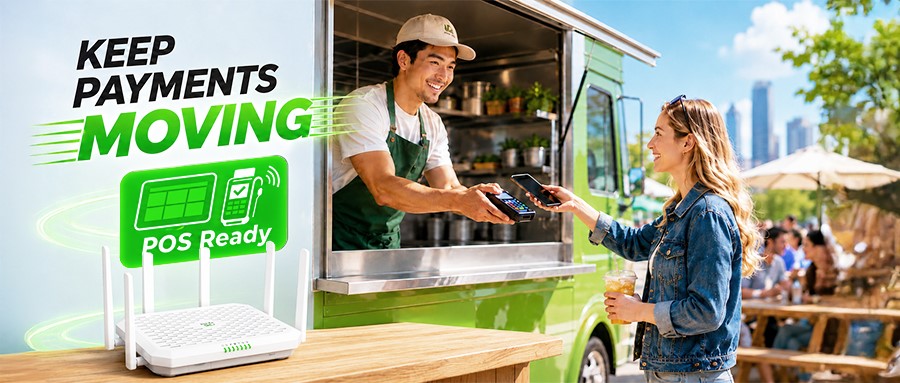
The company introduced POS Ready for the 5G FWA12. This one-touch feature prioritizes payment-related traffic on the device. Merchants activate it without complex setup. The system then gives priority to card payments, mobile wallets, QR code scans, and order confirmations. Other traffic continues but does not block the critical flows. InHand designed it specifically for retail stores, restaurants, pop-up shops, and branch locations where network contention is common.
FWA12 itself packs high-performance 5G with Wi-Fi 7 speeds up to 4200 Mbps. It handles up to 128 connected devices. The unit offers enterprise security, link redundancy, dual SIM plus eSIM support, wired and cellular backup, and intelligent self-healing. Cloud-based management runs through InCloud Manager. These capabilities make it practical where fiber installation costs too much, takes too long, or simply is not available. Businesses can also use it as cellular backup for existing wired setups.
POS Ready builds on that foundation. In cafes and quick-service restaurants, it protects QR ordering, counter checkouts, kitchen display updates, and delivery platform confirmations during peak hours. Retail stores gain support for fixed counters, mobile POS devices, self-checkout terminals, and temporary sales areas. Pop-up shops, food trucks, event booths, and remote branches benefit from fast 5G deployment paired with payment-first handling.
The Technical Director at InHand Networks put it plainly. Payments are not just another application. They represent the final step of the customer journey. POS Ready was built for that exact moment. One touch lets merchants protect payment traffic while everyday business and guest traffic share the same network.
Key benefits follow directly from the design. One-touch activation removes the need for on-site configuration headaches. Peak-hour resilience keeps checkout and ordering moving when multiple systems compete. Flexible deployment fits new stores, temporary venues, and locations with limited wired access. The overall networking stays business-ready with Wi-Fi 7 capacity, separation of business and guest networks, security features, link backup, and remote management.
InHand Networks brings real operational weight to this launch. Founded in 2001, the company focuses on industrial-grade connectivity. It serves business networks, industrial IoT, digital energy, smart commerce, and mobility. Its solutions reach smart manufacturing, smart grid, intelligent transportation, and smart retail across more than 60 countries, including the United States, France, Germany, the United Kingdom, Italy, and China.
This matters because modern customer-facing operations run on mixed traffic. Staff tablets update inventories. Cameras stream security feeds. Guests browse on public Wi-Fi. Delivery drivers pull confirmations. Cloud systems sync everything. When bandwidth tightens, payments often lose out without smart prioritization. POS Ready flips that script by design.
Consider a typical quick-service restaurant on a Saturday afternoon. Orders pile up. Phones connect to guest Wi-Fi. Kitchen displays refresh constantly. A single congested link can delay card swipes and QR scans. Customers wait. Lines grow. Some walk out. The feature addresses exactly this scenario by enforcing payment priority at the network level.
Retail promotions create similar spikes. Temporary counters pop up. Mobile POS units move around the floor. Self-checkout stations handle surges. Without targeted handling, these setups risk slowdowns that hurt conversion rates. FWA12 with POS Ready offers a deployable solution that scales with demand.
Remote and temporary locations face even steeper challenges. Food trucks and event booths need quick connectivity without fiber. Branch offices in areas with poor infrastructure rely on cellular. The combination of fast 5G rollout and payment prioritization gives operators confidence that transactions will clear even under load.
The broader picture shows why this fits current business needs. Many locations cannot justify full fiber builds. Others need reliable backup when primary links fail. FWA12 delivers high-performance 5G access with enterprise features. POS Ready adds the specialized traffic intelligence that merchants actually use daily.
InHand positioned the announcement around practical merchant scenarios. They avoided vague promises and focused on real environments: cafes, restaurants, stores, pop-ups, and branches. The technical integration stays straightforward. Activation requires one touch. Management happens centrally. Redundancy keeps connections alive.
Security receives attention too. The device includes VPN and firewall protection. Business and guest networks stay separated. These elements matter when payment data moves across the same infrastructure as public traffic.
Deployment flexibility stands out. New store openings often face tight timelines. Pop-up operations need instant setup. Seasonal demand requires quick scaling. FWA12 with POS Ready supports all these cases by combining cellular speed with targeted prioritization.
The company’s global reach adds credibility. Years of experience in industrial IoT and smart commerce inform the product. Customers in multiple continents already rely on InHand solutions for critical connectivity. This latest feature extends that track record into payment-sensitive retail environments.
Merchants and managed service providers gain a simpler path. No deep networking expertise is required to enable payment protection. The one-touch mechanism lowers the barrier. Remote management through InCloud Manager keeps oversight efficient even across many locations.
Longer term, this type of feature points toward more intelligent edge networking. Devices will increasingly understand business priorities rather than treat all traffic equally. Payment flows sit at the top for obvious revenue reasons. InHand made that hierarchy explicit and easy to activate.
The FWA12 hardware itself supports future growth. Wi-Fi 7 delivers high capacity. 5G provides speed and reliability. Redundancy options protect against outages. These specs create headroom for expanding device counts and application demands.
Retailers evaluating cellular options now have a clearer choice. Basic hot spots fall short under load. Enterprise-grade solutions with traffic intelligence better match operational reality. POS Ready tips the scale by solving a specific, painful problem.
Operators managing multiple sites will notice the difference. Centralized management reduces travel for configuration. Prioritization happens consistently across locations. Payment performance becomes more predictable even during unpredictable rushes.
InHand Networks continues building on its foundation in industrial-grade connectivity. The POS Ready addition shows attention to customer-facing use cases. It translates technical capabilities into direct business value at the point of sale.
This release deserves attention from anyone responsible for retail technology infrastructure. The problem it solves appears every busy day. The solution stays simple to deploy and focused on results.
The real test will come in live environments. Early indications from the design suggest merchants can expect steadier transaction flows when networks face pressure. That steadiness matters more than raw speed alone.
Alex Mercer has covered enterprise networking and retail technology for over fifteen years. He focuses on practical deployments that drive measurable operational gains.
Author bio: Alex Mercer, senior commentator for international tech publications with deep experience analyzing networking solutions for commercial environments.
source
https://newsroom.seaprwire.com/press-releases/technologies/the-checkout-crunch-how-inhands-pos-ready-turns-network-pressure-into-payment-protection/